| Hey Rookie Pool
The Gaffey Street Pool
| | For years, the Fort MacArthur Museum Association has vigorously campaigned for the preservation of the historic “Hey Rookie” swimming pool on the Upper Reservation, commonly known as the “Gaffey Street Pool”. The long-standing strategy was to prevent any severe modification or possible demolition of the site as sometimes was proposed. We are pleased to be able to report that as of 2015, the "Hey Rookie"/Gaffey Street Pool has received a new lease on life. Following is a message from the Fort MacArthur Museum director, Stephen Nelson. | 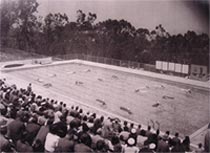
Opening Day of the Hey Rookie Pool 1943 | "Several years ago the Museum participated in a competitive grant program from the Port of LA at the urging of Dorothy Matich. The Museum won the grant for a total of $6.9 million to create an adaptive reuse plan for the old 'Hey Rookie' pool, usually referred to as Gaffey Pool. The Museum Association working on behalf of the City of Los Angeles Department of Recreation and Parks, has helped make this project a reality. Many months of work by the Bureau of Engineering and dozens of other entities has yielded the plans and renderings illustrated below. We feel that this will be a huge improvement to the Upper Reservation Historic District and will be a real benefit to San Pedro. Ground Breaking is scheduled for February 5th, 2015 with completion scheduled for June 2016. We will post periodic construction images and updates. Hope you all can join us for an opening day dip." This historic swimming pool was built through funds raised by proceeds from “Hey Rookie,” a show produced and performed by members of the Fort MacArthur Garrison. The show was developed during the early years of World War II and was performed for men stationed at the remote gun batteries of the Harbor Defenses of Los Angeles in order to increase morale.
The "Hey Rookie" show was an instant success and so popular that it was slated for public performances in 1942. After a few public venues, the show was selected to run at the Belasco Theater in downtown Los Angeles. The show remained at the Belasco for nine months when it was finally selected for performances overseas. The production was offered for troops in Africa, Italy and the China Burma India Theater of Operations. Many notable stars were associated with the show including the actor Sterling Holloway (the voice of Winnie-The-Pooh and countless Disney characters), J.C. Lewis from KHJ Radio, Tex Terry from Columbia Pictures and many other Hollywood personalities that found themselves in uniform during the Second World War.
After the departure of the “Hey Rookie” show for overseas duty, the swimming pool served the enlisted men of Fort MacArthur for recreational activities, and also served the new recruits that were processed at the Lower Reservation. During the war over 750,000 troops were processed through this Induction and Separation Center. Some of the new recruits did not know how to swim. Since the majority of these men were slated for overseas service via transport ship the pool became their first experience with swimming. | | Through the clever thinking of the Fort MacArthur Service Command, Olympic swimmer Howard Ploessel was detailed to manage the Hey Rookie swimming pool. Ploessel and his wife, Velma (a silver medalist in the 1936 Berlin Olympics) began to develop new ways of using the swimming pool to boost morale and help the war effort. Together they developed special shows called Aquacades. Mrs. Ploessel was a physical education instructor at both the San Pedro and Huntington Park High Schools. She selected swimmers from her teams to serve as the performers for the Aquacades. The girls were soon known as the Southern California Aquabelles (SCA) and performed regularly as the main attraction at the pool. In similar fashion to the “Hey Rookie” show the Aquabelles became an instant hit and were performing | 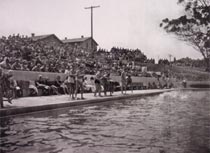
A view from the diving board on the
opening day of the Hey Rookie Pool 1943 | | throughout Southern California. The show was such a success that it became part of the war bond drive for the 7th War Loan.
Upon the conclusion of the 7th War Loan, the Aquabelles were credited with assisting a drive that raised $26,000,000. The SCA Aquacades also had many VIP’s as participants with their various shows. Edward G. Robinson, Joan Blondell, Johnny Weissmuller, Stubby Krueger and Miss America 1943 were all participants with the Aquacades. In addition to its historical significance the pool also has architectural significance as well, although this significance is greatly overshadowed by its historic significance. The pool is an example of mid-20th century modernism with stylistic details related to the Art Moderne style of the 1930s. It is markedly different from most swimming pools in its location, on a hillside, and that it was incorporated into a property used for military service.
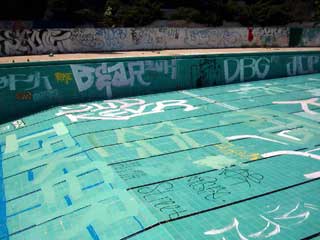
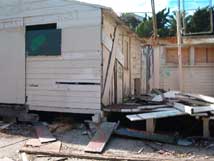
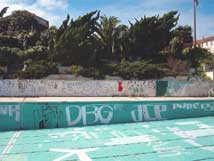
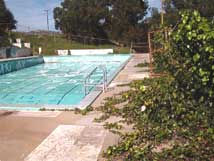
After the war, the pool continued to serve the troops of Fort MacArthur and the citizens of San Pedro. Later, the pool was opened to the public in addition to its military use. Special changing rooms and showers were constructed on its eastern side to accommodate the increased usage. Thousands of children used the pool during the 1950s, 60s and 70s. As the decades passed, the “Hey Rookie” show had regrettably faded from the public memory and the pool lost its signature name, and was now commonly called the Gaffey Street Pool. Regardless of its name, the pool continued to serve the public - even after the Army left the property in 1982, when it was turned over to the City of Los Angeles Department of Recreation and Parks. The pool continued operating until the early 1990s when it was closed and drained. Since that time, the pool was all but forgotten, stripped of its fixtures, overgrown, and vandalized. Recent years have been hard on the "Hey Rookie" Pool complex. A serious increase in vandalism caused a great deal of damage to the pool's tile surface and partially destroyed the building housing the civilian changing rooms that were built when the Army first started allowing public use of the pool in. Recently built fences, installed by the LAUSD, helped temporarily, but could never eliminate the problem of vandalism.
While the damage is significant and disheartening, it can, and now, will be repaired.
The "Hey Rookie" Pool will again be a positive experience and resource for the San Pedro community, rallying back from being a neglected and almost forgotten nuisance to again serving future generations as a legacy of Fort MacArthur. | | | |  | | Additional Projects | | | | | |